| |
The New York Times, Good Morning America, and New Scientist magazine have featured the work of researchers Gerald Friedland and Robin Sommer. The researchers looked at geo-tagged videos and photos on the Internet that contain embedded longitude and latitude coordinates. Users are often unaware that these coordinates are automatically added to images by higher-end cameras or smartphones such as the iPhone. Friedland and Sommer cross-referenced these coordinates with publicly available information — such as Google Maps Street View — to quickly identify, for example, the home addresses of posters to Craigslist. One search of YouTube videos yielded (in fifteen minutes) a home in downtown Berkeley whose owner was on vacation. The work will be presented at the Fifth USENIX Workshop on Hot Topics in Security (HotSec '10) in August. Read the conference paper here >> Read more about the research here >>
Orpheus Crutchfield, the executive director of the Berkeley Foundation for Opportunities in Information Technology (BFOIT), was profiled in the August 1 edition of the San Francisco Chronicle Magazine. BFOIT is an ICSI program that supports historically underrepresented ethnic minorities and women in technology. Through seminars hosted at UC Berkeley and ICSI, BFOIT inspires local high school and middle school students to pursue careers in computer science, mathematics, engineering, and information technology. The Chronicle profile highlighted Crutchfield's commitment to creating diversity and encouraging youth. Read the article online here >>
A UC Berkeley team led by Professor Pieter Abbeel, ICSI Vision Group leader Trevor Darrell, and Professor Stuart Russell is one of the winners in the Personal Robot 2 Beta Program, sponsored by robotics company Willow Garage. The team, which includes Speech Group affiliate Dan Klein, will be given a robot for two years, and will experiment with hierarchical planning, perception, and manipulation of deformable objects, such as towels. Read more about the team's plans for the robot here >>
Algorithms Group graduate student Bonnie Kirkpatrick has won a 2010 Google Anita Borg Memorial Scholarship. The award, given annually to female students in technology and computer science for academic excellence and leadership, includes a $10,000 scholarship and invitations to networking retreats at Google offices. It was established in 2004 to honor Dr. Anita Borg, the founder of the Institute for Women and Technology, and is dedicated to encouraging female scholars to become leaders in the fields of technology and computing. Read more about the award here >>
Jörg Lässig and Dirk Sudholt, DAAD-sponsored postdoctoral fellows in the Algorithms Group, received the best paper award in the Parallel and Evolutionary Systems track at the Genetic and Evolutionary Computation Conference (GECCO) in July. Three papers co-authored by Sudholt were nominated for best paper awards. DAAD-program alum Tobias Friedrich received an award in the Evolutionary Multiobjective Optimization track.
ICSI research in speaker diarization was presented at the Research@Intel 2010 Day on June 30. Speech Group researchers Adam Janin, Gerald Friedland, and ICSI Director Nelson Morgan presented the Meeting Diarist, a tool that recognizes who is speaking and what is being said, and allows users to search for relevant parts of a meeting's transcript. PC Mag featured the presentation in an article about the event >>
Vern Paxson of the Networking Group is quoted in an MIT Technology Review article on Internet security. The article describes recent attacks by botnets, groups of computers that are infected with viruses. These botnets are controlled remotely and are responsible for the vast majority of spam on the Internet. Networking's research on botnets has been featured in New Scientist magazine. Read the Technology Review article here >>
Architecture Group leader Krste Asanovic has been given the 2009-2010 Jim and Donna Gray Faculty Award. The award is given each year to a UC Berkeley Computer Science faculty member for excellence in undergraduate teaching. Previous winners include ICSI affiliate Dan Klein (2008-2009) and BFOIT advisory board member Daniel Garcia (2004-2005).
Algorithms Group members have been invited to give talks at three international conferences this summer. Group leader Richard Karp gave a keynote talk at the Annual Symposium on Combinatorial Pattern Matching, held in New York City in June, and Eran Halperin was invited to give talks at the 7th International Conference on Algorithms and Complexity, in Rome in May and at the 10th Workshop on Algorithms in Bioinformatics in Liverpool in September.
The Netalyzr system, developed by members of the Networking Group, has been featured in New Scientist magazine. The article encourages readers to try the system, which analyzes the extent to which a user's Internet service provider is interferring with its customers' traffic. To date, 130,000 users from 180 countries have tried the system. New Scientist also provides background information written for a nontechnical audience on the tests conducted by Netalyzr.The system, developed by Christian Kreibich, Vern Paxson, and Nicholas Weaver, has also been featured in an article in the Register. Read the New Scientist article here>> See the New Scientist background material page here>>
Paul Kay, a researcher with the AI Group, has published an article in the June 1 issue of the Proceedings of the National Academy of Sciences. The article is Kay's tenth on color naming and perception to appear in PNAS in the last five years. Read the article here>>
An interview with Professor Charles Fillmore, the director of ICSI's FrameNet Project, will appear in this year's Review of Cognitive Linguistics. The interview, Discussing Frame Semantics: The State of the Art by József Andor, comments on Fillmore's leading role in frame semantics and goes into recent developments in the field. Fillmore's contributions to semantics and linguistics were honored at the Workshop on Treebanks and Linguistic Theories in December 2009 and at a conference held in honor of his eightieth birthday in July 2009, Frames and Constructions.
Professor Dan Klein, an affiliate of the Speech Group, has been awarded a 2010 Distinguished Teaching Award, UC Berkeley's most prestigious award for instruction. The awards are given annually by the Berkeley Division of the Academic Senate's Committee on Teaching to recognize sustained excellence in the classroom, creative scholarly work, and the ability to inspire independent thinking in students. Klein will be honored at an awards ceremony April 22. More about the awards >>
Networking Group scientist Christian Kreibich was quoted by BBC News discussing the difficulties of filtering spam email. The article focused on harmless emails incorrectly marked as spam. Researchers at ICSI and UC San Diego recently developed a spam blocking method that, in initial tests, only filtered spam messages, with no false positives -- that is, legitimate messages marked as spam. The system exploits the spam-creating botnets that run in the background of users' computers by learning the templates the bots use and teaching spam filters to look for these templates. While this doesn't guarantee a 100 percent success rate in real life situations, it is a huge step forward in spam prevention. Read more about the system in the New Scientist article here >>. Read the BBC News article here >>.
ICSI held its annual BEARS Open House February 11. Professor Krste Asanovic, head of the Architecture Group, presented his group's work on photonic-based memory, Collin Baker led a demonstration of the latest improvements to the FrameNet Project, and Luke Gottlieb demonstrated Joke-O-Mat, an award-winning project by members of the Speech Group. Scientists from all groups presented posters summarizing recent results of various research projects. The open house is held annually in conjunction with UC Berkeley EECS Annual Research Symposium (BEARS).
ICSI Speech Group alum Matthew Aylett has developed text-to-speech software that allows film critic Roger Ebert, who lost his voice box four years, to speak in an approximation of his own voice. "It still needs improvement," said Ebert in a report aired on CBS, "but at least it sounds like me." Aylett's Scotland-based company, CereProc, broke down voice recordings from Ebert's film commentary into individual sounds, which are reassembled when Ebert types a sentence into the software. Ebert can also adjust the emphasis and intonation of the synthesized sentences. CereProc offers a number of other voices produced from text, including voices with Irish, Scottish, Southern English, and American accents. Ebert's new voice debuted on the Oprah Show in March. See the CBS news spots here: Roger Ebert to Speak Again >>, Company Restores Roger Ebert's Voice >>, and Roger Ebert's Second Act >>.
Speech Group scientist Dilek Hakkani-Tür was quoted in The LA Times explaining some of the technical difficulties of transcribing spoken language to text in a column February 7. Scientists in the ICSI Speech Group are actively researching ways to make machine transcription of human speech more accurate, as well as creating algorithms to assist computers in making sense of the resulting transcriptions. Read the column, "Speech and Handwriting: Where's the App?", here >>.
A sequel to Brent Berlin and Paul Kay's then-controversial 1969 book Basic Color Terms is being published by CSLI Publications and is expected to be available in mid-February 2010. The new book, World Color Survey, is authored by Paul Kay, Brent Berlin, Luisa Maffi, William R. Merrifield, and Richard S. Cook. Kay and Cook are members of the AI Group at ICSI. Basic Color Terms, together with subsequent research published in numerous journals and conference proceedings over the last 40 years, has shaped our understanding of the relation of color language to color perception and has influenced current thought on the broad question of linguistic relativity. World Color Survey extends the breadth and depth of Basic Color Terms with systematic data on each of 110 additional languages. It includes a detailed analysis of the color terminology system of each language. Available as a pre-order from CSLI Publications >>
Networking Group scientists have released a complete version of Netalyzer, a tool that detects when your ISP (Internet Service Provider) is interfering with your connection in some way. Cade Metz reported on Netalyzer for The Register, a United Kingdom news publication, in an article titled "Boffins Birth Uber 'Net Neutrality' Dowser: Eye on Your ISP." Christian Kreibich of the Networking Group is quoted several times, explaining the service and how it will benefit ICSI research. Along with Kreibich, Vern Paxson and Nicholas Weaver, also from the Networking Group, worked on the Netalyzer system.
Professor Eran Halperin of the Algorithms Group and Tel Aviv University in Israel received one of six 2010 Krill Prizes for Excellence in Scientific Research. The prizes are given annually to faculty members at universities in Israel, and come with a $10,000 award. More about the Krill Prize >>
Professor Jerome Feldman of the AI Group received a 2009 Berkeley Citation, given for academic achievement and service to UC Berkeley. He was cited for work in computational cognition and neural networks, leadership in interdisciplinary research, and support of the Berkeley Foundation for Opportunities in Information Technology (BFOIT), an ICSI program that supports underrepresented minorities and women in science and engineering. More about the award >>
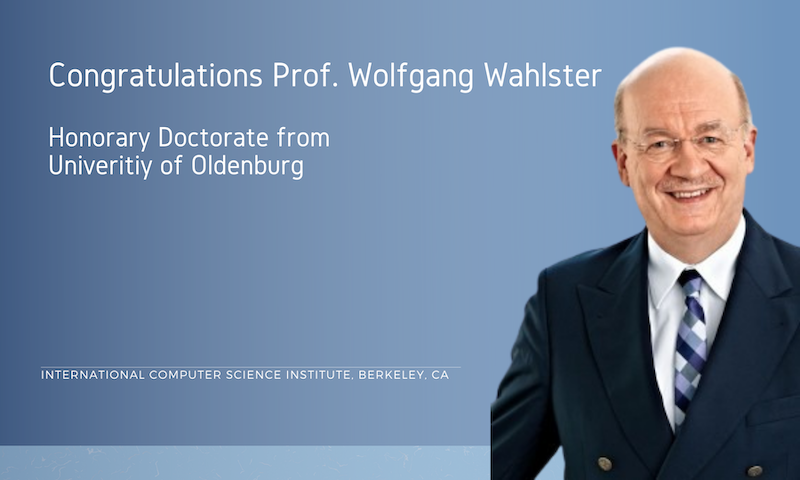
ICSI Board of Trustees member Wolfgang Walhlster will be the first chairman of the TZS Scientific Advisory Board. TZS is a new German company using data analysis to address urban management challenges. More >>
ICSI's Brazilian visitor program has issued its first annual call for applications, and is set to begin in 2010 as soon as participants have been selected from the pool of applicants. The program offers exciting opportunities to expand worldwide collaborative research for ICSI scientists.
The ICSI team led by Dr. Gerald Friedland of the Speech Group has won the Grand Challenge at the Beijing ACM multimedia meeting. Their project, Joke-O-mat, was a response to the Yahoo! video challenge. Joke-O-mat is designed to parse sitcoms by identifying main characters, the best jokes (signaled by the loudest and longest laughs) and scene changes. It was developed by Friedland, Luke Gottlieb, and Adam Janin. More >>
top |
|
ICSI Gazette

March 2010 (pdf)

September 2009 (pdf)
|